The first Fix Pack for WebSphere Service Registry and Repository is now available. The support site only lists a single APAR fix but thanks to Arnauld for pointing out the README file that details the substantial set of improvements that come with this release:
I’ve been putting together a VMware image based on RedHat over the past couple of weeks and the last step was to try and reduce it in size from a massive 18Gb (28Gb if you included the snapshots). Given that 5Gb of this was free space, this should have been relatively easy to achieve. The original disk wasn’t created at a fixed size and, having removed any snapshots and set the disk to be independent-persistent the Shrink panel of VMware tools finally became active. Unfortunately, it only showed the boot partition.
Rational Application Developer and WebSphere Integration Developer both come with a piece of functionality known as the Web Services Explorer. Part of the unit test client, this provides a user interface for invoking WSDL defined Web services. Until now, I’ve always used the Explorer by right-clicking on a piece of WSDL and selecting Web Services > Test with Web Services Explorer. This is all very well if the WSDL happens to be in your workspace. What I hadn’t realised until this week is that you can also use the Explorer with any arbitrary URL addressable WSDL.
One of the beauties of WebSphere Service Registry and Repository product is it’s flexibility. The development team have begun a new developerWorks series looking at customizing the web based administrative console. The first article covers the basic architecture and concepts but the series promises to go on to cover the ultimate in customization: a new perspective.
Over the past month or so my laptop has been driving me slowly insane. It’s performance has been absolutely dire, particularly when trying to work under VMWare. I’ve spent many hours staring at the task manager looking for rogue processes that might explain the constant disk thrashing but to no avail. Process Explorer (one of the Sysinternals tools now owned by Microsoft) came to the rescue indicating that, for example, when running VMWare, 50% of the CPU was being used to handle hardware interrupts.
We headed over to the Forest of Dean today for Bristol Orienteering Klub’s district event at Moseley Green. I went out on the brown course and was pleased to discover that the planner’s primary concern seemed to be to ensure that competitors saw the best bits of the area and didn’t have to fight their way through too much of the bramble infested woodland (even if this meant the odd dog leg in to and back out of a control).
We’re in Monmouth for the weekend visiting the in-laws and, to celebrate Christine’s imminent birthday, we went out for dinner at a new restaurant named Bistro Prego. This was only their third night so the service was a little random (the third bottle of wine to arrive at our table was the one intended for us, the waitress was unsure as to what some items on the menu actually were, and we sent the bill back as they’d missed off a few items). This is, perhaps, forgivable as I suspect Monmouth doesn’t have a particularly large pool of trained serving staff to call upon! The food, however, was absolutely superb.
On the basis of a thread of notes I was involved in this week, I was considering a post on the WebSphere Application Server support for JMS providers that don’t implement the Application Server Facilities (ASF) part of the JMS specification. As the name suggests, these facilities cover aspects of integration between a JMS provider and a J2EE application server such as transactionality and message-driven bean support. Paul Titheridge (who works in the service team covering the WebSphere MQ and WebSphere Application Server JMS providers) has done the hard work for me and written a developerWorks article on the subject.
In a previous posting I covered the Feature Pack for Web services. This week’s developerWorks Making SOA real with WebSphere podcast includes an interesting interview with Nathan Goike on this subject. Points of particular interest to me was the inclusion of Apache Axis2 and the use of policy sets to ease Web service configuration.
Keys Botzum has provided updates to his security hardening and programming presentations, written in combination with my UK colleagues Cameron Martin and Peter Kovari, to cover Version 6.0 and 6.1 of WebSphere Application Server.
Finally found the time to upgrade to WordPress 2.0.5. The process of copying across all the modified files, plugins, themes etc. is always far more manual than I’d like so if you spot anything that looks broken please let me know!
Ben Bakowski, Chris Whyley and Matt Roberts have written a nice developerWorks article introducing WS-Notification in WebSphere Application Server Version 6.1. For once I’ve actually sat down myself and worked my way through it so I know it’s good! It illustrates the use of a publisher, asynchronous consumer and pull point for lightweight consumers, along with mixing WS-Notification and JMS. One thing to watch out for though: the authors have chosen to use scripting for the setup and pre-written applications which, although providing useful examples, means it’s easy to get to the end of the article without knowing what you’ve done if you don’t take the time to look at the content of the scripts and code.
I’ve had a couple of queries in the past week about whether or not service integration bus messaging engines using a database for the message store need an XA capable JDBC data source. Thanks to Gareth Bottomley in the development team for locating the appropriate section hidden away in the InfoCenter that indicates you should configure a Connection pool data source i.e. non-XA capable. The messaging engine does not use the XA capabilities of the database, instead acting as a resource manager in its own right. So, for example, when you receive a message under a global transaction it is not deleted from the data base at that point under a JDBC transaction. Instead, it is non-transactionally marked with the Xid of the global transaction so that it is not received by other consumers and then, only when the transaction is commited, is the record removed. This is particularly important to note when using Oracle as the database as the Oracle XA driver has notoriously poor performance.
We went over to the BADO district event at Chawton Forest Park this morning. Yesterday’s sunshine was still with us and it was a pleasure to be out in some of the more runnable bits of the forest. This was probably just as well as I didn’t have the best of runs on the Brown course. My legs felt tired, my cold still hasn’t gone away completely and I have failed to do anything about my ankle since the OMM. On top of this I wasted at least five minutes on just three of the controls.
We went over to the New Forest this morning to meet up with Christine’s latest orienteering protégé. We had a nice short run from Turf Hill in the glorious sunshine. It was a day for being outside so, after lunch, we went for a walk round the local woods in Knightwood and Valley Park. Some fantastic autumn colours on show although I suspect they won’t last much longer.
Had an uneventful journey back from Austria although the M3 was pretty hairy in the torrential rain. Made it home in time to accompany Christine to the Royal Hampshire Hospital in Winchester for her dating scan. The ultrasound produced some very clear pictures. The baby appeared to be resting its head on one arm and it was good to see that it already appears to be practising running! The hospital is currently training its staff to perform nuchal fold testing (already on offer in Southampton and which NICE recommends all hospitals provide by April 2007) and, as a thank you, we got a free selection of pictures to take away.
Busy day today. Sweated off the remainder of the last night’s alcohol with a morning run. After grabbing a bite to eat (and having another interesting breakfast-time conversation with a colleague) I went to Luc Maquil’s presentation on WebSphere Process Server performance. Luc is one of the authors of the WebSphere Business Integration V6 Performance Tuning Redpaper and consequently knows a thing or two about the subject.
I wasn’t due to present until late afternoon today so decided to make the most of the bright sunshine and do a little sightseeing. I repeated my route from Monday morning although this time I had to pay to get in to the Hohensalzburg Fortress. Some of the internal attractions were a bit naff but the audio tour was worth the wait if only to make it out on to the top tower.
Many of the presentations at the conference are repeats from our internal services conference earlier this year which means I have some spare time to catch up on other work. One session I did go to today was Eric Herness (Chief Architect for WebSphere Business Integration) presenting the new content in Version 6.0.2 of WebSphere Process Service and ESB. I think it’s safe to say this is a refresh pack with more than a few functional enhancements!
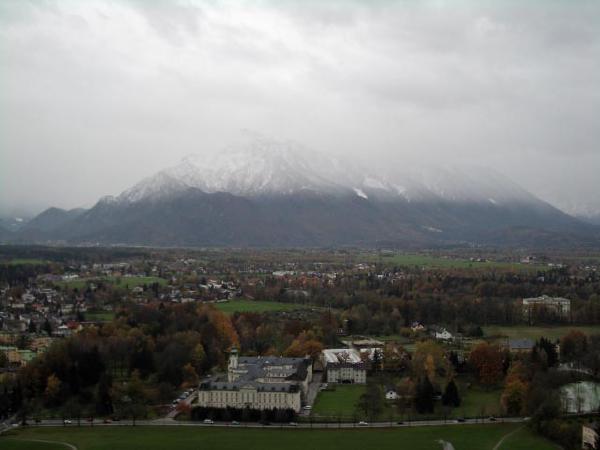
Went for a run first thing this morning despite the grey skies outside. I crossed the river from the hotel and climbed the hill opposite, following it along to the fortress. The gates were wide open so I just ran on in. There was no-one around and I just continued on up the steep slope to the fortress terrace, snapping photos as I went. Only when I eventually made my way back down to town had someone appeared in the pay booth at the entrance.