The WebSphere Application Server administrative console isn’t always the easiest beast to navigate and I often find myself having to repeat those five clicks to get back to the page I was just on a moment ago and wishing that there was some sort of bookmarking support. I’m therefore surprised I’ve failed to spot the My Tasks support in Version 6.1 before, which goes at least part of the way to solving that problem.
The WebSphere Business Integration Performance Tuning Redpaper has now been updated to cover Version 6.0.2 of WebSphere ESB and Process Server. The information in this paper comes from the product development performance teams and, if anyone knows how to squeeze the last ounce out of these products, it’s those guys.
Arnauld Desprets and Laurent Rieu are two of IBM’s European leaders in the SOA governance space so it’s worth reading their developerWorks article on implementing and enforcing a service lifecycle with WebSphere Service Registry and Repository. A reminder though that WebSphere Integration Developer isn’t the only mechanism to create SACL and OWL files.
Yesterday saw my first orienteering since the JK - a local event at Micheldever Forest between Winchester and Basingstoke. Christine decided to stay home as she didn’t reckon pushing the pram up and down the car park track would be all that much fun so I hitched a lift with Sam Massey.
REST versus SOAP is one of those holy wars it doesn’t pay to get too passionate about. Each has its own merits, for example the simplicity of REST versus the transport neutrality of SOAP. It was therefore interesting to read a developerWorks article that describes how the HTTP binding in WSDL 2.0 enables REST-style interactions for Web services. As the author indicates, this support doesn’t let you do everything you could with a truly REST based service but it’s good to see the WS-* spec writers taking the move for simplicity on board.
There is an interesting developerWorks article covering the JAX-RPC Web Services support in WebSphere Application Server Version 6.1. It demonstrates how this support alone can provide some of the benefits normally associated with an enterprise service bus, namely location transparency (WSDL endpoints can be overridden in the administrative console) and protocol transparency (SOAP/HTTP, SOAP/JMS or RMI/IIOP). As the article goes on to state, the combination of WebSphere ESB and Service Registry and Repository can give you much more dynamic behaviour when trying to achieve the first of these but if all you need is the ability to modify endpoints when, for example, moving from the development environment in to production, then this may suffice.
The WebSphere Integration Developer InfoCenter contains a section on creating your own mediation primitive to sit on the palette alongside the standard set of primitives. If you prefer learning by example, then Russ Butek has a developerWorks article out that leads you through the steps to create and deploy a simple primitive that writes all or part of a Service Message Object out to the console. (A handy primitive to have in your toolkit in its own right.)
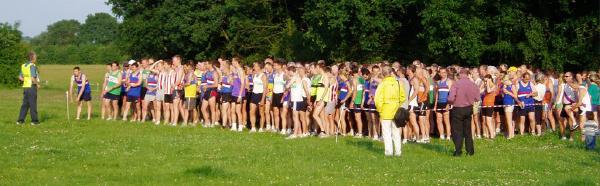
It was the fifth RR10 last night, taking place at a sunny Itchen Valley Country Park. I had an audience this time as Christine and Emma both came along. My legs felt a bit stiff from Tuesday night’s run in the forest - perhaps not surprising given it has been my only run in the past week. I started fairly fast, partly because I had forgotten just how far you have to go on the third lap of the course. Annoyingly though, my current lack of training seemed to pay dividends as, although I started too slowly, I still managed to move up the results again, finishing in 12th place. This just pushes me in to the top ten for the series so far. It was also great to see IBM Hursley Runners men’s team take an impressive 7th place.
If you’re going to put all of your services in to a single registry along with the artefacts that describe them then security is going to be important to you. WebSphere Service Registry and Repository has a comprehensive fine-grained access control mechanism based on the industry standard XACML. There is a developerWorks series starting which describes the details. (And no, I’m not just plugging it because Gary was once my mountain marathon partner!)
As I’ve mentioned previously, shortly after I first joined IBM I was a member of the development team for the transactions component, initially of Component Broker and then WebSphere Application Server. My team leader back then was one Ian Robinson. Ian has since risen to the heady heights of Senior Technical Staff Member and I’m glad to say that he now acts as my mentor. Ian is co-chair of the OASIS WS-Tx committee and, as announced on his blog (of which I had no idea of the existence), Version 1.1 of the standard has just been announced. Ian has also added his name to the list of contributors on the WebSphere Community Blog (note the new location) having authored a lengthy article on the support for Web Service Transactions in WebSphere Application Server.
After taking in to account the suggestions received and spending far too long staring at a huge selection in the hardware store, I ended up going with the mouse poison. As the guy at the checkout kindly reminded me, I’d selected the option to give the intended recipient the most pain and suffering! I needn’t have worried about hunting down decaying bodies though. The poor wee beastie had cleaned out the tray and was lying in-situ, on its back, with its feet in the air. After a suitable burial (not easy finding an empty spot in our garden) the poison tray was refilled and, I’m glad to say, remains undisturbed.
Christine’s Mum has been staying with us since the weekend which has enabled me to get out and about in the evenings - Tuesday night run and pub and then RR10 yesterday. The rain had stopped earlier but I suspect half-term meant numbers were a little down at the race. Although sluggish my legs didn’t feel too tired - probably a result of four days enforced ‘rest’ over the weekend. That and, in the last couple of kms, I knew that the pain was nothing compared to with what Christine had been through! I finished in 15th place - my best so far this year.
Christine and Emma came home from hospital on Tuesday and are settling in well at home. Emma continues to sleep well between feeds - at least during the day. Unfortunately 2am-4am seems to be when she is at her liveliest! At least there is plenty of opportunity to catch up on sleep during the day. Christine is recovering well and seems to be getting stronger day-by-day. We made it out for our first trip round the block this evening.
At 23:37 on 26 May 2007, Emma Claire Currie was born at the Royal Hampshire Hospital, Winchester, weighing in at 8lb13oz (4kg). The birth was by caesarean section following a long and painful labour. Emma is sleeping and feeding well and enjoys wriggling and sticking her tongue out. Christine is tired but well. Daddy is very proud of them both.
I’m not sure “nice” was the right word to use about the state of affairs when I arrived at the hospital in Winchester. Christine had been having painful contractions throughout most of the night and the co-codamol they had given her had caused her to be sick. However, when she was eventually moved to the labour ward around one o’clock she was a promising 5-6cm dilated.
We went in to Winchester hospital yesterday afternoon where Christine was due to be induced. One prostaglandin tablet later and after hours of monitoring (don’t believe a midwife when she says “just another five minutes”!) the contractions were coming along nice and regularly when I left late last night. The pain was starting to kick in a little for Christine, probably not helped by the screams from the neighbouring labour ward! She was due another monitoring session this morning and, given that at half six in the morning I’ve just had a call asking me to come in (after getting some breakfast otherwise I wouldn’t be writing this) then I guess things are still moving along nicely.
So, here goes… there’s plenty to say so my overview of Ruby on Rails is going to be a multi-parter. Note, this isn’t going to be a tutorial - there are plenty of those about. This is my view on what makes Rails hot and where it’s not based on my experiences as a Rails newbie. My background, for reference, is with J2EE professionally, and PHP on the side.
A couple of months back I was looking for somewhere to host a Ruby on Rails app (of which more in another post shortly). In the end I settled for a Virtual Private Server from US firm Slicehost (who are themselves Rails developers). For just over £10 a month I get 10GB of storage, 100GB of bandwidth and 256MB. Bargain! I’d love to use a host in the UK but I’d easily be paying twice that and getting half the spec (unless someone out there can point me at a good deal I’ve missed).
No - no baby yet. These tiny feet are entirely unwelcome and were heard scampering around the loft last night. I poked my head up there and shone a torch around and could only make out what appears to be a wasp nest. Fortunately that looks to be unused. No sign of any rodent activity. Now the moral dilemma - should I get an old fashioned spring-loaded mouse trap or something to keep the wee beasty alive? To be honest, I’m not worried about killing the mouse, it’s clearing up afterwards that bothers me! Browsing around, it’s interesting to read that house mice are unlikely to survive when released in to the wild anyway. I was amused by this article on an award by PETA to the inventor of a “humane mouse trap” (where “humane” means they get gassed rather than having their necks broken.)
Another useful fact I picked up at WSTC was around retry behaviour for JMS exports. Pamela Fong and Jeff Brent have put together a very detailed developerWorks article covering all aspects of exception handling in WebSphere Process Server and WebSphere ESB. Definitely worth trying to get your head round this stuff.