Unlike many others, I was disappointed to hear that the London Underground strike was suspended late last night. The trains in to London have been fantastically empty the past two days. So much so that a young couple boarding my carriage last night enquired whether they had mistakenly entered first class!
We spent last weekend in the Czech Republic at the wedding of our (currently Southampton based) friends Petra Hajkova and Petr Junek. Things didn’t get off to a good start with the Thomsonfly flight from Bournemouth to Prague delayed by an hour and a half. This meant Emma wouldn’t wait for the feed that Christine had hoped to give her on the ascent and then had just dropped off sleep when it was time to board. Emma screamed a bit when the doors were closed but, greedy thing that she is, eventually settled in to a feed and then proceeded to sleep for most of the flight.
A question from a colleague had me wondering about the following restriction stated in the WebSphere Application Server Version 6.1 pre-reqs:
IBM WebSphere MQ 5.3 CSD 12 and IBM WebSphere MQ 5.3.1 for z/OS + PK10303 are supported for client mode connections only.
Yesterday evening we headed over to the University playing fields at Eastleigh for the running club’s time trial event. The two and a half lap course was near enough 5km (give or take 50 metres) and the time of 17:51 I clocked was pretty much what I would have expected. With a little better preparation (arriving more than five minutes before the start having not spent the afternoon sat in meetings and no long runs in the New Forest on the proceeding two days) it would be interesting to see how much faster I could go. Christine, I suspect, was just happy to make it round, with Emma staying very well behaved for the period whilst we were both out.
I’m back at work this week and with a vengeance: a six week engagement in London. The customer’s adjacent to Paddington station so I’m taking the train up via Reading. So far this has been pretty painless with trains on time and even getting a seat except on the section from Reading in to London. This morning the passengers were an odd mix of the normal suited commuters and the (Wellington) booted Reading Festival goers. The only slight annoyance has been that, so far, my 6:30 start in the morning has seen me getting up before Emma.
WebSphere Application Server has shipped with JAR files for the WebSphere MQ JMS provider since Version 5.0 as they were, at the time, required for the embedded messaging provider. However, if those JAR files do not match the version of WebSphere MQ you are using (as is the case with WebSphere Application Server V6.0 and WebSphere MQ V6) you may see error messages such as java.lang.NoSuchFieldError: msgToken. As documented on the support site and in the InfoCenter, on the server-side the correct thing to do is update the MQ_INSTALL_ROOT WebSphere variable to point to your real WebSphere MQ installation. What I haven’t seen documented anywhere is what to do in the case where you are using the WebSphere Application Server client container. In that scenario, you need to modify the JMS_PATH environment variable defined in the launchClient batch file in the application server bin directory.
Aggregation isn’t currently one of the capabilities available out of the box with WebSphere ESB but it’s something a number of people have asked me about in the past, particularly those from a WebSphere Message Broker background. I was therefore particularly pleased when Russ Butek showed me a draft of a developerWorks article he was putting together which demonstrated how to achieve aggregation using a custom mediation primitive. Looks like that article has now been published so you can now read all about it for yourselves.
I’ve mentioned one of my colleague Paul Titheridge’s articles before (on JMS Application Server Facilities) and he’s just started a new related series which is well worth taking a look at. This time Paul has turned his attention to the myriad of connection pool properties provided by WebSphere Application Server and what they mean when using WebSphere MQ as the JMS provider. As before, Paul has provided some thoroughly worked examples to help explain the implications of changing different values.
No - I haven’t been reading Harry Potter all of this time. We’ve been away on holiday for the past couple of weeks and without network connectivity for most of that time. Our primary destination was the Scottish 6-Days orienteering event held on Speyside, up in the Highlands of Scotland. However, we decided to make the most of my being off work and have a fairly leisurely drive up there showing off Emma to various relatives on the way.
Apologies for the lack of posts at the moment but any spare time is currently being consumed by Harry Potter! It wasn’t entirely coincidental that we found ourselves in our local ASDA on Sunday afternoon, picking up one of the last of their 5000 £5 copies of Harry Potter and the Deathly Hallows. Christine tends to be a faster reader so I agreed she could go first. I hadn’t, however, bargained on her reading it out aloud to Emma as I went in and out of the room. So, now we’re all reading it together which, as you might imagine, is a little slower going…
Having covered the Model and Controller aspects of Rails in previous posts, that really means it has to be View next. I’ve already touched on the basics: the controller method renders a template, either explicitly or simply by exiting and allowing the default template for the action to rendered, and the attributes of the controller class setup by the action method are then available to the template.
Wednesday saw what was probably my last RR10 of the year (we’re likely to be away for Stoke Park Woods and IBM hosts the last race of the year). It was a new course for me, out at Janesmoor Pond in the New Forest. I was warned that it was undulating and wasn’t disappointed (my watch measured over 300m of ascent in 6.8km which is positively mountainous for round here!). The course also now leaves the gravel tracks to cut through the middle of the first loop meaning there was also be some mud to be had.
Andrew is plugging the draft of his Redbook Connecting Enterprise Applications to WebSphere Enterprise Service Bus over on SOA Tips ’n’ Tricks and rightly so as it’s well worth a look. If you thought that WebSphere ESB was just about SOAP/HTTP then this book should set you straight. It covers details of integration via WebSphere MQ, JDBC and HTTP and connecting to CICS. I’ve been working on the labs for the corresponding ITSO Workshop rolling out later this year.
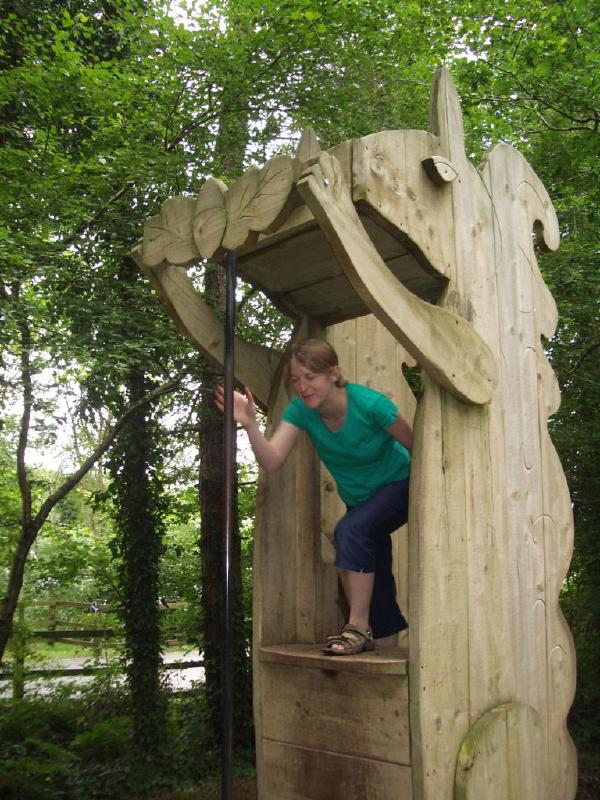
Yesterday we headed over to Itchen Valley Country Park for the afternoon. As you can see, Christine had fun on the play trail whilst Emma slept. We then went for a walk round the woods and up to the top of the meadows - all fairly pram friendly if a bit muddy given the recent weather. We’ll have to remember to avoid Monday or Tuesday next time though as the cafe is closed.
We were visiting Christine’s parents in Monmouth last week and on Thursday had a trip out to the Wye Valley Butterfly Zoo at Symonds Yat. There’s only the one medium sized glasshouse but it’s home to a good collections of butterflies. Emma didn’t last more than a couple of minutes inside though as it’s kept pretty humid. You’re given some identification cards which I’ve used to label most of the photos I took but there are two I haven’t got: one I forgot to label before deleting my photos of the cards and another that didn’t appear on the cards at all. If you know what they are, please let me know!
Many thanks to Ilya Azarov who answered my plea for assistance and supplied his nginx rewrite rules for Gallery2. I won’t claim to understand why his work and mine didn’t (although previously I wasn’t aware that you could nest location directives so that was something I hadn’t tried). They still can’t cope with spaces in file names but I can live with that.
I’ve had a nice shiny T60 on loan for the past couple of months for a project I’ve been working on. Unfortunately the time came to return it, at which point I thought I’d try out the free version of VMware Converter. This enables you to take a physical machine and convert it to a VMware image. The idea was that I would create an image of the laptop before giving it back in case there was something on it I still needed.
So, it’s been a little bit quiet on this blog for the past few days. The main reason is that it’s been on the move from the hosting provided by our ISP (PlusNet) to my SliceHost slice. Things would have been much quicker had I not decided to switch Apache for the increasingly popular (due to its low memory usage) nginx.
Yesterday the Dorset Coast Path Relay was blessed with the first sunshine for weeks. The route runs from Lyme Regis along to the ferry terminal at the end of Studland Bay. I was down for a leg from Lulworth Cove to Kimmeridge Bay. My pre-race preparation wasn’t ideal: Christine fed me my lunch as we were driving down; the combination of the team being 25 minutes ahead of schedule at this point and fighting our way through the sun seeking traffic meant I had just half an hour for my legs to unwind; and I was still watering the bushes when Matt Whipple was spotted sprinting down the hill towards us!
I’ve mentioned the IBM Client for JMS on J2SE with IBM WebSphere Application Server on a couple of occasions. As the name suggests, this provides you with a couple of JAR files that allow a standalone J2SE application to act as a JMS client to the WebSphere Application Server default messaging provider. What it isn’t good for, is acting as a client from another, third-party, application server. Yes it may work but you don’t get all those good things that an application server provides, like XA transaction coordination and parallel message consumption using MDBs. Enter the IBM Resource Adapter for Java Message Service with WebSphere Application Server which allows you to do just these things. Note that it’s currently only tested on Apache Geronimo V1.2 and WebSphere Application Server Community Edition V1.1 but it’s a JCA 1.5 compliant resource adapter so should work with any J2EE 1.4 application server. Also note that, as with the original client, this download is initially only available with an early access license. If you are interested in using it in production though, drop a note to the e-mail address in the technical support section.